










Today I am making public a project I have been developing for some time:
Quantum Doubled Bitcoin — BDQ / QBtc
It is not a new cryptocurrency being launched onto the market.
It is not a fork of Bitcoin.
It does not propose creating 42 million bitcoins.
And it does not claim that the quantum infrastructure required to run such a system already exists today.
It is a conceptual proposal built around a question that may become increasingly important over the coming years:
What if we used the same quantum principles that could threaten Bitcoin to build a new layer of security and processing around Bitcoin itself?
That question is the origin of Quantum Doubled Bitcoin.
The Paradox
Quantum computing is usually discussed within the Bitcoin ecosystem as a threat.
A sufficiently advanced quantum computer could potentially compromise some of the cryptographic techniques currently used by Bitcoin, particularly elliptic-curve digital signatures.
But there is another possibility.
What if quantum physics were not only a threat?
What if some of its principles could also become part of the solution?
BDQ explores precisely that possibility.
The proposal conceptually applies three principles:
- superposition;
- entanglement;
- quantum no-cloning.
And applies them to a monetary architecture inspired by Bitcoin.
The “Doubled Bitcoin” Concept
This is the central idea.
A bitcoin would not be duplicated.
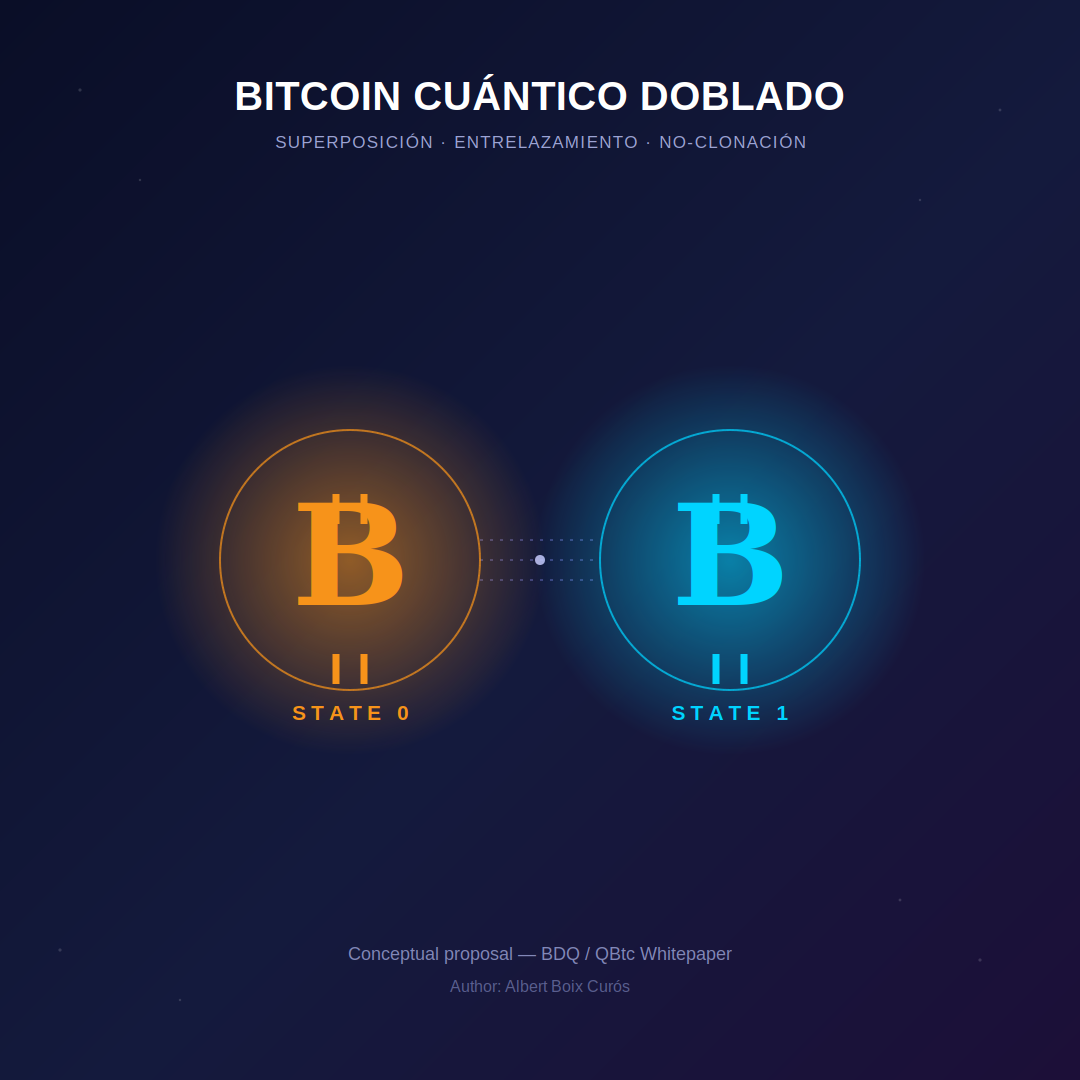
Instead, it would be represented through two correlated states:
state0
and
state1
Both would belong to the same economic identity.
They would not be two bitcoins.
They would be two synchronized functional representations of the same unit.
While an operation remains unresolved, both states could participate within the architecture.
When a definitive transaction occurs, the system determines one valid final state.
The other state loses any independent economic capacity.
In other words:
doubling does not mean duplication.
Bitcoin’s fundamental monetary limit would remain:
21,000,000 BTC.
No additional 21 million bitcoins would be created.
What the architecture attempts to multiply is the functional capacity of the system, not its monetary supply.
Why Do This?
Bitcoin solved one of the fundamental problems of digital monetary systems:
double spending without requiring a central authority.
BDQ introduces a second question:
Could a future quantum architecture reinforce that property through physical mechanisms in addition to cryptographic ones?
In real quantum systems, the no-cloning theorem establishes that an unknown quantum state cannot be perfectly copied.
That principle becomes particularly interesting when applied to digital money.
Because one of the essential properties of scarce digital money is precisely that a unit cannot be spent twice.
BDQ explores the possibility of connecting these two ideas.
From Classical Blockchain to a Hybrid Architecture
The project does not propose destroying Bitcoin and replacing it with something entirely different.
One of the architectures studied is a hybrid model:
Classical Bitcoin + Quantum Layer
Proof of Work could initially remain the underlying security mechanism.
An additional layer could operate above it to manage correlated states.
This would make it possible to experiment without requiring an immediate transformation of the Bitcoin protocol itself.
In the longer term, the proposal also conceptually explores a model called:
Quantum Proof of Work — qPoW
But precision here is essential.
The quantum infrastructure required to run a global monetary system of this kind does not yet exist.
That is why the project clearly separates:
what can be simulated today
from
what might eventually be implemented using real quantum hardware.
The Interesting Part: We Can Start Before Quantum Hardware Is Ready
We do not need to wait twenty years to investigate the concept.
A significant part of Quantum Doubled Bitcoin can initially be developed through classical simulation.
The technical roadmap begins with:
Phase 1
state0 / state1 files interconnected through cross-referenced SHA-256 hashes.
Phase 2
Simulation of accounts and transactions using Python and SQLite.
Phase 3
Dual contracts that execute only when specific conditions in both states are simultaneously satisfied.
Phase 4
Parallel processing and synchronization between the two channels.
Phase 5
Experimentation through Layer-2 systems, sidechains or smart contracts.
Only later would it make sense to migrate selected components toward real quantum infrastructure.
Dual Quantum Smart Contracts
One of the most interesting derivatives of the concept is the possibility of creating contracts with two correlated conditions.
For example:
STATE 0 → Condition A
STATE 1 → Condition B
The contract would execute only when both conditions are coherent.
This could open new models for:
- digital identity;
- custody;
- certification;
- voting;
- intellectual property;
- asset exchange;
- proof of existence;
- conditional financial systems.
At that point, the architecture stops being merely a monetary proposal.
It begins to become a new way of thinking about the relationship between information, state and value.
Is This Really Quantum Computing?
Today, no.
And that distinction is fundamental.
The white paper does not claim that a functional quantum implementation of BDQ currently exists.
The first stage uses classical computers to simulate the logic of dual states.
Actual quantum computing would enter later, once hardware becomes sufficiently large, stable and fault-tolerant to experiment with architectures of this kind.
For that reason, BDQ should currently be understood as:
a technological hypothesis + a conceptual architecture + an experimental roadmap.
Not as a finished product.
An Idea Must Be Falsifiable
There is one point I consider especially important.
A serious technological proposal should not merely attempt to prove that it works.
It should also attempt to discover where it fails.
That is why the next step for Quantum Doubled Bitcoin is not simply to build marketing around the idea.
It is to build.
Simulate.
Measure.
Attack the model.
Search for inconsistencies.
Attempt to produce double spending.
Analyze synchronization failures.
Determine whether the state0/state1 architecture actually provides a technological advantage.
And allow other people to criticize it.
If the idea survives those tests, it evolves.
If part of the model is wrong, it must be corrected.
That is how research works.
The White Paper
I have brought the complete concept together in the document:
Quantum Doubled Bitcoin
BDQ / QBtc
The white paper develops:
- the quantum threat to Bitcoin;
- the conceptual foundations of BDQ;
- the state0/state1 architecture;
- hybrid consensus models;
- Quantum Proof of Work;
- preservation of Bitcoin’s 21 million supply limit;
- possible Layer-2 and sidechain implementations;
- dual smart contracts;
- scalability;
- security;
- related academic and technological projects;
- an implementation roadmap;
- a 2025–2035 strategic roadmap;
- and mechanisms for documenting authorship.
Original concept author:
Albert Boix Curós
Authorship pseudonym:
Buboqa-IZOI ex Satoshi Nakamoto
And Now the Important Part Begins
Publishing a white paper does not prove a technology.
It only establishes a hypothesis.
The next stage is to transform that hypothesis into code.
The immediate objective is to construct a first simulator capable of representing:
BTC
↓
state0 ↔ state1
↓
cross-verification
↓
transaction
↓
single final state
From there, it becomes possible to start determining which parts of the concept survive contact with real engineering.
Bitcoin itself emerged from the combination of technologies that already existed:
cryptography,
hashes,
Proof of Work,
peer-to-peer networks,
digital signatures,
and incentive theory.
The innovation came from the architecture that connected them.
Quantum Doubled Bitcoin begins with a similar intuition:
perhaps the next major leap will not come from inventing one entirely new technology,
but from discovering a new combination between
Bitcoin + post-quantum cryptography + superposition + entanglement + no-cloning + distributed architectures.
That is what I want to explore.
The experiment starts now.
Quantum Doubled Bitcoin — BDQ / QBtc
“An idea that is not fixed is like a particle: it only exists when someone observes it.”
Link White paper
Bloque BTC 961740